Saturday, 5 October 2013

REVIEW: 21st Century Dodos, by Steve Stack

21st Century Dodos, by Steve Stack catalogues the technology, customs and even confectionary which so many of us grew up with. Like a car-boot salesman he manages to handle this collection of memorabilia with great care and respect whilst humourously reflecting on its enduring place in our hearts.

There might no longer be room in our fully synced, on demand and high definition world for Dickie Davis, Spangles and Pen friends but Stack acknowledges the enormous contribution that they, and their like, made to the world we grew up in.

He gives credit where its due as well to the ZX81, the recordable cassette and the calculator watch; clunky electronic devices which paved the way for the development of the ipad, the mp3 and the android.

It is painstakingly researched without ever being nerdy and consistantly funny without ever resorting to the obvious cynicism that obsolete technology inspires.

Bring back the Texan bar!

Monday, 19 August 2013

REVIEW: Pocket Notebook, by Mike Thomas

REVIEW: Pocket Notebook, by Mike Thomas


PC Jake Smith is about to bring a whole new meaning to Zero Tolerance. Outwardly he is the copper’s copper, a second generation police officer and a member of the elite armed response unit. The implacable enemy of lager louts, he bristles with state of the art tactical equipment, he can bench over a hundred kg without breaking sweat and can read the street like a map.


But, after fifteen years he is angry. Angry at the leniency shown to repeat offenders, at the beurocracy of the modern force and its stifling political correctness and angry at the steady and irreparable breakdown of his marriage.


His body courses with steroids while his mind begins to blur the line between his role as entry man for the firearms unit, his playstation and his collection of Vietnam DVDs.


Its all about to go horribly wrong...


Pocket Notebook brings together the tactical fluency of Andy McNabb with the spiraling maddness of Bad Lieutenant  and the hopelessness of Generation X with the quirky Cameraderie of End of Watch. Shotguns, steroids, hookers, bleeding knuckles and white hot rage. PC Smith has the road to hell in front of him and we are all along for the ride.


Five stars.

Thursday, 27 June 2013


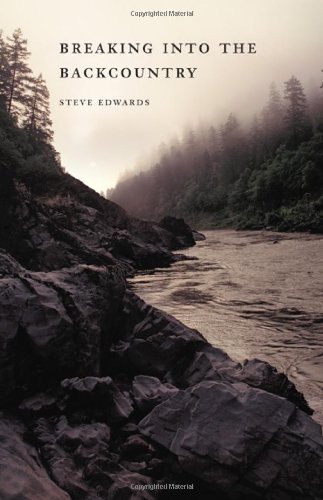
My favourite stories almost always involve ordinary people in extraordinary circumstances so when college lecturer Steve Edwards set forth, alone, into the wilderness, wearing the wrong boots and filled with trepidation, I knew I would enjoy reading about what followed.


As writer in need of peace and quiet, spending seven months as caretaker of a ninety-two-acre backcountry homestead in Oregon’s Klamuth mountains is a perfect opportunity to immerse himself in his work. As a newly divorced twenty-something its the chance to lick his wounds and move on, but from the moment he arrives at the homestead it is clear he has embarked on a life changing experience.


From the outset it is also clear he is no zealous mountain athlete out to pit himself against nature in a do or die struggle to the finish and neither, despite his lack of relevant skills, does he descend into a primal frenzy of guns, traps, knives and camoflage.


Instead, this is the story of a man of peace, although not necessarily a man at peace, who spends seven months in one of America’s last great wildernesses. Its written with a keen eye for detail, a deep love of nature and a gift for lyrical prose that makes you read and re-read certain passages over and over.


This is a book for anyone who has spent time alone on the trail and felt the need to share an epic sunset. It is for anyone who has heard the sound of their own heart beating after making eye to eye contact with creatures they have only seen on TV.


Its also a book for anyone who wants to know what it feels like to hear  a creaking floorboard in an empty and remote house at night or what goes through someone’s mind when they find a bear on their lawn eating from the apple tree.


Whether alone on the homestead’s deck, watching the night sky or hiking the Rogue River trail Steve beckons us to his side to share these moments of silent wonder, terror and self doubt.

A five star story.

Friday, 21 June 2013

REVIEW: Five Pairs of Shorts by Richard Wall

Muscle cars, a box of priceless undiscovered records, a briefcase full of cash and the control room of a nuclear submarine. These are just some of the props in Richard Wall’s Five Pairs of Shorts, a collection of ten short stories guaranteed to turn any dreary commute into an edge of the seat experience.

Locations and characters are penned with a few vivid lines and the stories quickly build momentum from there, each one winding up to  a sucker punch in the dark or a clanging frying pan to the head.

There is no clumsy attempts at deliberate misdirection here, instead the stories have an inbuilt feeling of impending disaster for at least one of the protagonists and its with an almost sick sense of anticipation that we can watch it unfold.

I read The Fat Elvis Diner a few months back and bought this off the back of it. I’m very glad I did!

Wednesday, 5 June 2013

Jack Reacher: The return of an 80’s icon?


Jack Reacher: The return of an 80’s icon?


Director Christopher McQuarrie recently brought Lee Childs’s Jack Reacher to the big screen and portrayed him, faithfully, as a man who has chosen to live on the edge of society. He avoids the internet, mobile phones and electronic bank accounts. He also prefers public transport, motels and grubby diners to any semblance of a settled lifestyle. As a hero he might lack the keyboard skills of Jason Bourne and the dress sense of a latter day James Bond but he has all  the charm of Thomas Magnum, all the lethal skills of Kane, from Kung Fu and all the anonymity of David Banner. Combine this with an ability to drive a dodge charger recklessly, sense a tail and handle assault by multiple goons, and you have the sort of action hero we haven’t seen since the days of John McLean.


Even the film’s villains, a group of  crooked property developers, have a reassuringly 80’s feel. They are the sort of ruthless and uncomplicated adversaries that Hannibal Smith or Michael Knight might have encountered in a small, dusty town in America’s midwest rather than some shadowy government agency, or syndicate of high tech operatives out to crash the internet.


However, Reacher’s  chosen lifestyle, that of rootless drifter, with his scant possessions and reluctance to form attachments does make him seem out of place at times and leads Public Defender Helen Rodin to ask, ‘You don’t live in the real world at all, do you?’


Whether he does or not, Jack Reacher is arguably a tougher adversary in ‘the real world’ than he would have been in the pre-digital one he seems to belong to. After all, the avenues of research that the police resort to nowadays are useless in the hunt for a man with no social media profile, no hotmail account, no smartphone, no images posted on instagram and whose only weaknesses appear to be leather bomber jackets, muscle cars and loose women.


And yet, he can read people with an easy assurance that twitchy Jack Bauer would have died for, he has the old fashioned detective skills we never see on CSI, and he can kick butt as well as any of the  legions  of shallow vigilante/mercenary/ex-soldiers played by the likes of Jason Statham, Mark Whalberg or Tom Hardy.


Jack Reacher, for me, represents the welcome, and long overdue return of an 80’s action adventure icon, that of the lone traveller whose highly developed sense of right and wrong outweighs his need for anonymity. A man who will come out of the shadows to fight for the underdog and who, when justice has been served, will quietly move on.

It’s certainly worked out better than Sylvester Stallone’s recent attempt to recreate another iconic 80’s figure, that of the muscle bound, gun toting mercenary who recently returned to the big screen with ‘The Expendables’ and its sequel, both of which looked more like a flimsy pretext for a reunion gig than an attempt to recreate an iconic species of action hero.

Thursday, 30 May 2013

REVIEW: The Drowning of Arthur Braxton


The Drowning of Arthur Braxton

The north west of England is being battered by storms of biblical  proportions and at their epicentre, on a stretch of rain lashed seafront stands  an abandonned and semi derelict public baths, scheduled for demolition.


There are some who believe that the old building holds within it the power to heal, while there are others who say that only death is to be found behind its crumbling facade and boarded windows. Whatever dark secrets it holds it is far from deserted.


Welcome to the Oracle, a place peopled by characters who seem lost and cut off from the world outside; poor damaged Laurel, the stern and secretive Silver, the ghostly old twins Kester and Pollux and the graceful, innocent Delphina with whom Arthur falls hopelessly in love.

The Oracle is dark, dreamlike and filled with wonder but to Arthur, who first came here to escape the rain it becomes a place to shelter from the loneliness and despair of his life outside.

Thursday, 23 May 2013


This is billed as the opening of a three part novella and having finished reading it last night, in one sitting, I’m almost disappointed to know I’m already a third of the way through.

Rene cares for her sick mother in their delapidated homestead somewhere in the deep south of 1950’s America. Despite her mother’s tough-as-hoof-tacks southern grit and Rene’s rock steady calmness it is clear that Lilah is dying. A chance encounter offers the possibility of a cure from an unexpected source but both Lilah and Rene have grave misgivings.

There is darkness here but it is definately not of the clumsy unremmitting variety. Instead it is its pierced with flashes of hope and kindness. There is also intimate and unpleasant graphic detail associated with Lilah’s illness but again, it is not the centre piece of this excerpt and serves instead to add a sense of urgency neatly counterbalencing the deadpan Southern dialogue.

Eric Shonkwiler’s style is redolent of Faulkener’s As I lay Dying, not just in its setting and premis but most strikingly in its use of isolated imagery and plausibly dispassionate narration.